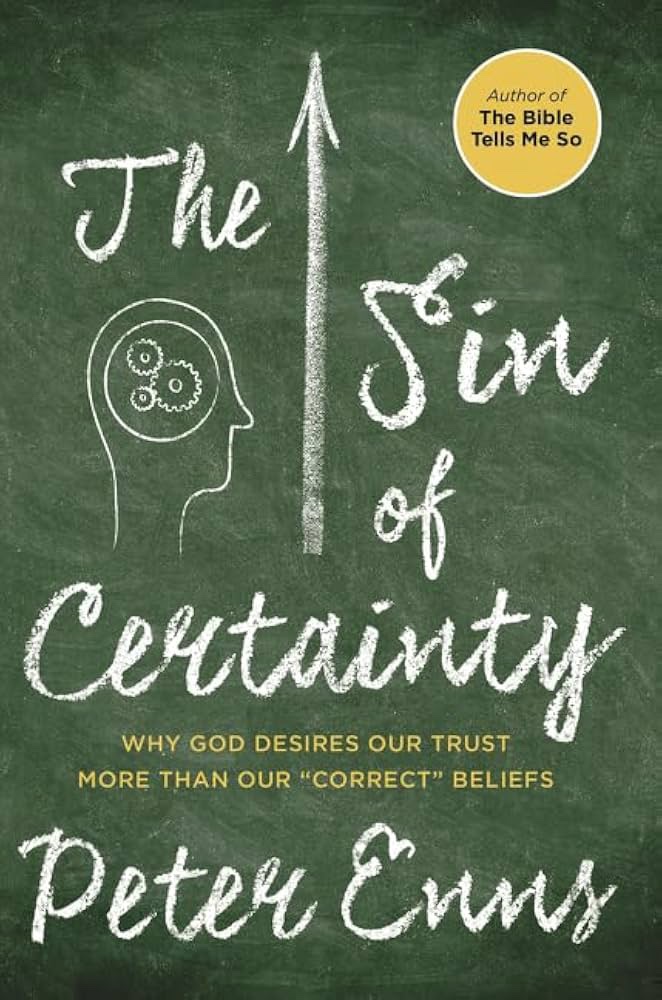
The Sin of Certainty
A book review — faith, doubt, and the courage to trust
What the book says
Enns is a biblical scholar, trained at Westminster Theological Seminary and Harvard, who spent years inside a faith built on having the right answers. Then the answers stopped holding. The book opens on an airplane, where Enns is watching a Disney movie and finds its picture of God ringing truer than the one he was taught. He calls those moments “uh-oh moments,” when what you thought you knew no longer fits, and says they are not the end of faith but the invitation to a deeper one.
His argument turns on one sentence: faith is not the same thing as being certain about what you believe.
“Aligning faith in God and certainty about what we believe and needing to be right in order to maintain a healthy faith, these do not make for a healthy faith in God. In a nutshell, that is the problem. And that is what I mean by the ‘sin of certainty.’”— Peter Enns, The Sin of Certainty
Certainty becomes a sin, in his telling, when it turns into an idol. When needing to be right matters more than trusting God, we shrink God down to the size of what we can understand, and then we worship the understanding instead of God. It is the golden calf again, only the idol is made of ideas instead of metal.
Enns traces how Christians got here. In the late nineteenth and early twentieth centuries, Darwin and biblical criticism shook traditional belief, and much of the church answered by gripping its doctrines harder. Correct thinking became the test of real faith. Doubt became disloyalty. But the Bible itself, Enns argues, never asked for that kind of certainty. The Psalms argue with God. Job demands answers and gets a whirlwind instead. The Bible is full of people who trust God while saying out loud that they do not understand him.
The alternative Enns offers is not doubt for its own sake. It is trust. Not trust in your own thinking, but trust in a person. “Decouple our faith in God from our thoughts about God,” he writes. “That way faith doesn’t rest on correct thinking.” Beliefs still matter, and he says so plainly. But they are not the center. Trust is.
Across nine short chapters, Enns moves from his own story through the history of the argument and into the parts of the Bible most churches skip.
Worth knowing
A fair review has to say what the book does not do. Enns is better at diagnosis than at prescription. The first half of the book, the part that names the problem and traces its history, is the strongest. The second half, on what a life of trust looks like day to day, is thinner. The guidance is real but general, and a reader who wants practical steps may find it light.
And some readers will simply not buy the premise. If you believe faith requires settled answers, this book will frustrate you, and it is built to. Enns refuses to hand you a new set of certainties to replace the old ones, and that refusal is the point, but it means the book offers a direction rather than a destination. Some of his counsel is familiar ground, the kind of thing any honest pastor has said on a hard Sunday. The book’s strength is not novelty. It is permission: permission to stop pretending you know, and to trust anyway.
Who should read it
Anyone who has ever had an uh-oh moment and kept it quiet. Anyone who has watched faith get used as a weapon. Anyone who has questions they have never said out loud. And anyone tired of performing certainty who would rather learn to trust.
If this book spoke to you
The people this book speaks to are the same people “A World of Pretenders” was written for. Readers wrestling with faith, doubt, and the demand to be certain. The song asks the same questions the book does. Is there a heaven? Is it a lie? Who can you trust when the holy are broken?
The song is written from Matthew 10:16, wise as serpents and harmless as doves, and its pretenders are people performing certainty, wearing faith like a costume and loudly sure. The book makes the case for trust over certainty. The song stands on the same ground. If the book spoke to you, hear the song.
Start with the song, or hear the lyric taken apart verse by verse in the lyric audiobook.
Hear the song
A World of Pretenders — the full song (3:07). Written by Franklin McKay and Harry Hess.